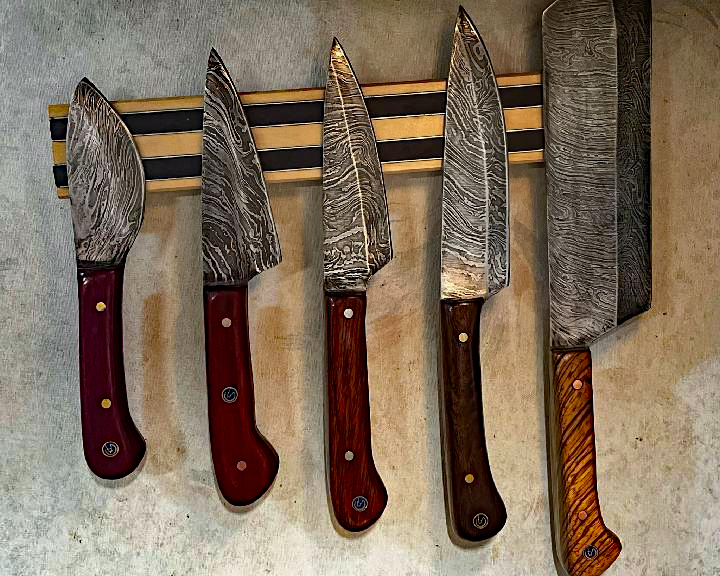
Sometimes we have a knife, or knives, that we have sort of “loved to pieces”. This was the case with the set you see pictured here. The lady used them a lot and while the blades themselves are excellent, the handle material left a bit to be desired. over time the black plastic cracked and chipped away. I really wish I had remembered to photograph the set before I started work on them.
The client asked me to put new handles on them all. Her only problem was, she couldn’t decide which wood she liked the best. In the end, she asked me to do each knife in a different wood. She picked her set up this afternoon and sent this photo this evening. I had warned her that keeping them in the leather knife folio she brought them in was not good for them and suggested she get a magnetic bar to store them, rather than the case or in a drawer. It looks like she took my advice to heart!
Damascus, San-mai, Wootz, Forge Welded, and Eletro-Etching
There seems to be some confusion as to what is Damascus and what isn’t. Real Damascus can usually only be found in museums. The secret recipe/formula was lost over 200 years ago.
Modern day “Damascus” is actually a steel combination that the original Damascus was made of, and can be found in a steel combination known as ‘Wootz’. What we are calling Damascus today is actually “Forge Welding’. Layers of different types of steel are stacked in together; heated to a critical temperature; then pounded out and folded over and put back into the forge and reheated to critical temperature. This is done multiple times. The resulting piece of Forge Welded Steel can be anywhere from 3 layers to thousands of layers. The more layers, the more expensive the blank will be. This stuff is bought by the inch not by the foot like other steel.
San-mai is a type of Forge Welding that uses a High Carbon Steel center which is sandwiched between more pliable metals. This makes the resultant steel tougher and more flexible than a straight High Carbon Blade. It is often mistaken for Damascus, but if you look at the spine of the blade you will see a dark strip running down the middle of the blade with lighter colored steel on each side as in the image below.
On a Forge Welded blade, if you examine the spine you will see hundreds of tiny lines running the length of the blade spine. These are the layers of folded steel. That is how you can tell a real Damascus blade from a fake one. There are two types of the fake stuff coming out of the Middle East. One looks and feels like the real deal – however, the steel used is very inferior steel that will not hold an edge. The other one again ‘Looks’ like Forge Welded steel, but when you feel the blade it’s surface feels rough and looks crude in comparison to the real steel. I’ve bought some of this stuff from the Middle East and taken the belt grinder to it only to find it is a plain steel that has been etched to look like a Forge Welded blade. There are no layers of different metals. People often ask if my knives are Damascus. They are not, unless I specifically say so in the write up on them. They have been ‘Eletro-etched’ and I do not TRY to make them look like Damascus.
We moved to Omak, WA in December 2021 and it took a few months for me to get the knife making shop set up the way I want it. It’s still not 100% there, but at least I’m able to work and build knives. Which is a good thing because I’ve sold a couple more knives! In fact I’ve sold FIVE in just the past month!
I am so pleased that folks in the area like my work.
I’m working on a couple of new designs that I’ve been tweaking over the last couple of weeks. Some of them are going to be one off’s as they were a real challenge for me – like the dagger – been there, done that, now moving on.
But there is the ‘Just Basic Camp Knife’ and a couple others that are just that. I enjoy making each one because no two are the same. That knife is the ‘Day Tripper’. I’m going to keep making those but my best seller I’m not making any more – I just made the last one. I’ll post pic’s once they are all done and I have the sheaths made for them. This Last One is the last of the PuP series. It is 440C etched with 200 year old American oak and purple heart scales and it comes with one of my hand crafted leather sheath. ANYWAY I’ll post pic’s.
The man who helped design the Kenai Moose Skinner is an off grid musher named Bill Laughing Bear. He lives out on the Kenai peninsula in Alaska. In honor of his contributions, I gave him the first edition of the knife. Yesterday he sent me this image.
It seems he had the first opportunity to give it a workout when a moose wandered into his yard! He let me know he was able to skin the whole moose without having to sharpen the knife once! While the D2 steel is a real pain to get sharp, it stays sharp!
I will be a vendor at the Kingman Gun and Knife Show at the Mojave County Fairgrounds Saturday and Sunday, March 14 and 15, 2020. Among the knives for sale will be TWO Kenai Moose Skinners, one in South American Ziricote wood and the other in Arizona Desert Ironwood. You will find both of them on the Knives for Sale page if you’d like to preview them.
If you’re in the area, come on by and see if there is something you’d like to buy!
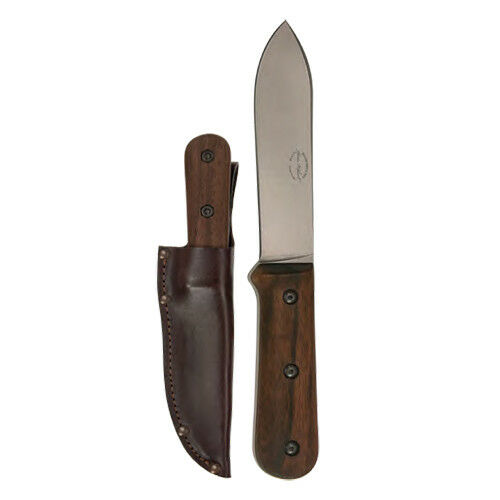
The K-Bar KephartI subscribe to all 3 of the prominent knife magazines and every issue is read from cover to cover… more than once. As I am a custom knife crafter (stock removal) I always pay particular attention to the knife reviews. To be honest I have always wondered whether or not the articles were biased in favor of the maker. One of the magazines did a review of K-Bars new release of the Kephart Knife and I bought the K-Bar ‘Kephart’ based on that review. Sorry to say, I was more than a little disappointed with their product (and consequently decided that there is definitely a bias).
The steel is good (1095 CroVan Carbon Steel) and I really like the finish K-Bar used on it. I also really like the knifes design (designed by Mr. Horace Kephart in 1897) and the thickness of the blade. I was also impressed with the quality of the sheath although it was not true to form for a Kephart reproduction. Unfortunately, ‘my’ review goes downhill from there.
First off K-Bar used nuts and bolts to secure the handle material instead of steel pins. Then they placed the nuts facing out rather than the bolt heads (Very tacky looking and an obvious lack of quality control?).
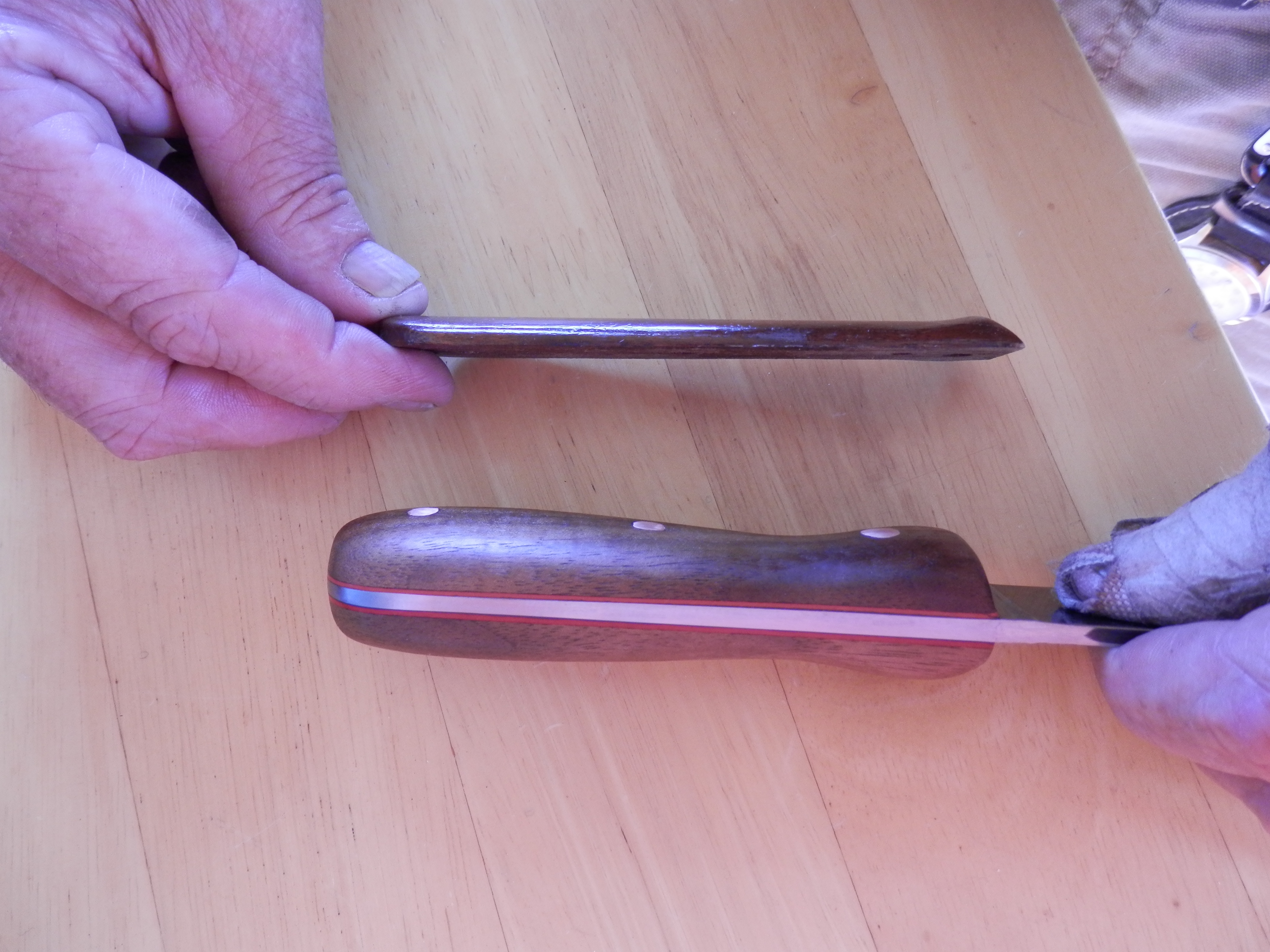
K-Bar scale above. The knife remade with my own walnut scale below.
The “walnut” grips were not epoxied onto the tang and when I removed them after my testing, the tang was heavily rusted. I am well aware that in Mr. Kepharts time there was no epoxy, but then again there was no rust inhibiting coating like K-Bar used either. I’m all in favor of using modern technological advantages if it improves the quality and extends the life of the knife and is not blatantly obvious.
In that same vein – the walnut scales were not stabilized or finished with anything (raw wood) and I was getting small chips of wood coming off at the finger guard. The handle also ended up being very scarred up from use. Treating the wood with Tung Oil or some other hardener would have helped prevent this from happening. This is the first time I’ve received a knife with an unfinished handle. I also found the knife handle way too thin, which resulted in hot spots and difficulty in gripping it under serious use… and I do not have a large hand. Since it is a reproduction, maybe the measurements taken were of an old and worn handle and that’s why it is so thin?
Given the quality of the K-Bar version, I would have priced it at around the $80 mark rather than the $119 I paid. Having said all that – I really like the knife (thanks mainly to Mr. Kephart) and it will become my EDC once I finish modifying it to my liking.
“….It was a rough looking affair when I received it, neither ground nor polished. Every cent of its value had been put into material and temper, leaving me to beautify it as I might wish.” (Horace Kephart)
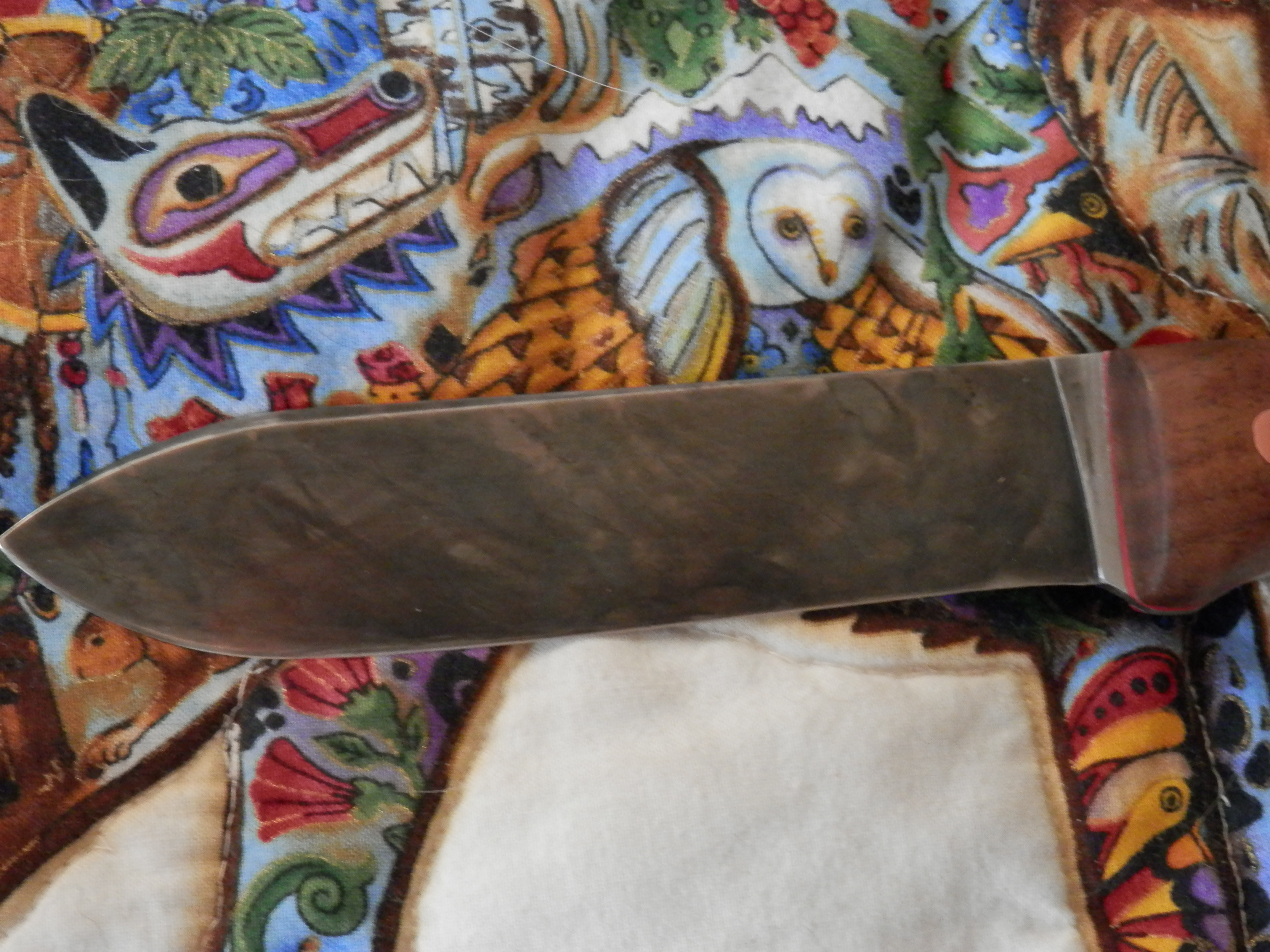
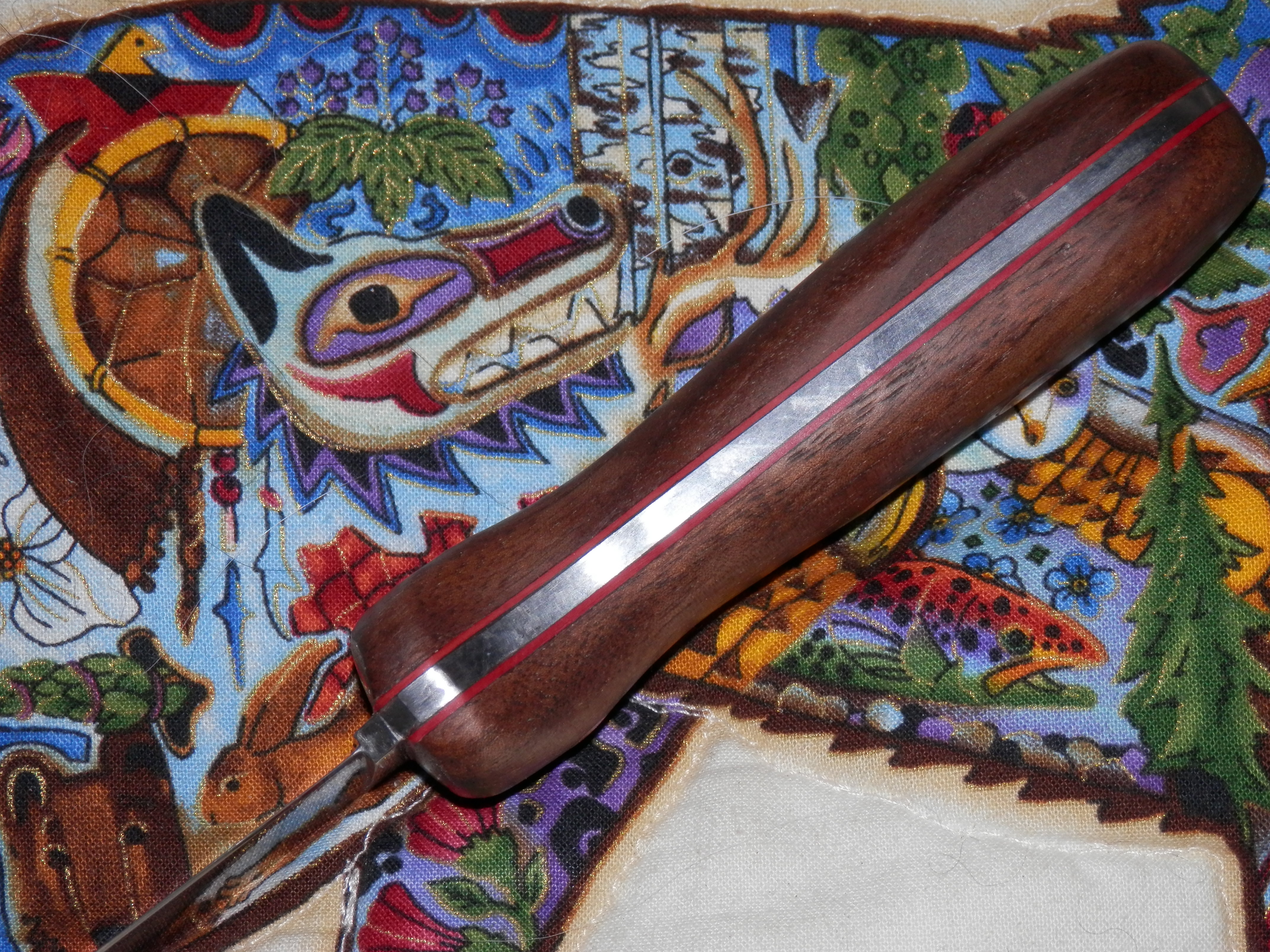
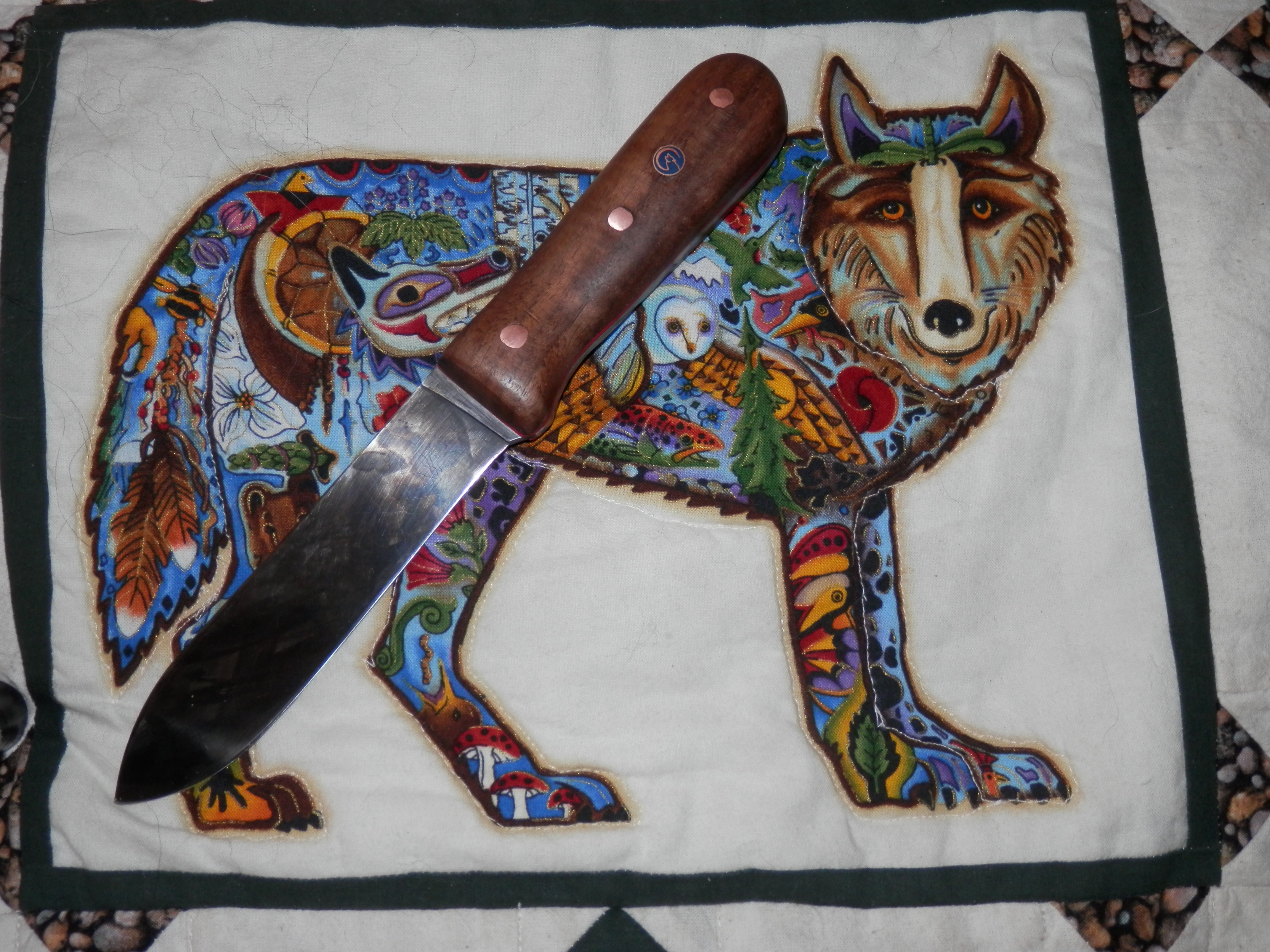
So that’s exactly what I’m doing. I am beautifying it as I wish. Thicker stabilized walnut grips with a red fiber liner (both epoxied on), peened copper pins and a Tung Oil/Linseed Oil finish. On mine I did a mustard etch and a partial bluing of the blade, just my own personalization of ‘my’ knife.
Blueing and mustard treatment modification I made to finish on the blade.
I added red G-10 liners.
My completed modified knife with blueing/mustard treatment on blade, new heftier walnut scales, red G-10 liner, copper pins and my logo pin.
I am in the process of making 4 more that will be for sale in about a month. So if you bought a K-Bar Kephart knife, and are not quite as happy with it as you thought you’d be, and you like what I’ve done with mine, and leave a message or email: moondogknives@gmail.com. And I can “beautify it as YOU wish.”
If you find Mr. Kepharts knife design aesthetically pleasing, as I do, and want to know more about the knife and the man – pick up a copy of Knife Magazine or go to www.knifemagazine.com. They did an outstanding article that intrigued me enough that I went to Amazon and got one of Mr. Kepharts books.
It seems that there is some confusion regarding the two knives I did for Mike Neal (Pictured above – Photo by Mike Neal) – I did not forge make the ‘Forge Welded’ blades.
The Filleting Knife (At the top in the image of both knives) is a piece of American Forge Welded steel bought unworked, and it is somewhere around 512 layers. I shaped the slug and put an edge on it, an amazing edge, which should hold up well. I used some Desert Ironwood for the handle.
Mike sent the brisket/sashimi blade to me (Lower in the image of both knives and the solo image) with some incredible pieces of wood in exchange for making him a knife. He wanted to know whether it was “Real Forge Welded” steel and if I could do something with it. I tested it with Ferric Acid and ‘Super Blue’. It IS “real”, but I have no idea where it came from so I don’t know the quality of the steel. I re-beveled the edge and honed it to the best edge I could get (I use Japanese ‘Water Stones’ and ceramic rods). It took a half decent edge, but time will tell if it is made with good steel and will hold that edge. I also refinished the surfaces, then made the handle out of some of the curly Koa Mike sent me. You can’t see it in the picture, but it has a pattern similar to ‘Tiger Stripe Maple’ or ‘Quilted Maple’ which I’ve never seen in Koa before. My wife tells me Curly Koa is quite rare and very much in demand… when you can find it!
I had made 2 of the fillet knives already in ‘440C Stainless’ that Mike saw and decided that was what he wanted. Well, I really wanted to give him a ‘Nice” knife (so he’d send me more of his scraps) and wanted to do it in Forge Welded steel. But I could/can not afford to screw up on a piece of this stuff because it’s so expensive! You buy it by the inch, not foot like “regular” steel. The two stainless ones I previously made were a nightmare for me to do and I won’t be making any more of them (It wasn’t as bad as trying to get 4 bevels on one blade! I went through a lot of good steel making the Defender 01 and quite honestly, it’s selling for less than the cost of all that steel I wasted!
NOTE: Do not let your knives get dull. It is MUCH easier to touch up a sharp blade than it is to put an edge back on the blade that you can’t cut yourself with.
Unless otherwise specified, your knife was made with a ‘High Carbon Steel’ (1095, 1084, 1075, D2-Tool Steel or 440C). Because it is NOT ‘Stainless Steel’ you will need to take care of your knife or it will rust (stainless also will rust under the right circumstances). Also it will obtain a ‘Patina’ with use. This (and any rust) can be easily removed with a green scrub pad and some powder cleanser or you can use a 1000/1200 grit sandpaper, used very lightly. Apply an oil to the surface from time to time, any oil will work but I use A.G. Russell’s ‘Rust Stop’ (Food Safe). I’ve had the bottle several years now and it still almost full. So a very tiny dab is applied and spread VERY CAREFULLY with your finger or use a cotton swab. Start at the spine and rub down towards the edge. Do NOT store the knife in it’s sheath for extended periods of time as the chemicals used on the leather will eventually cause corrosion (even on stainless).
How often should you sharpen your knife? I use a ‘High Carbon Steel’ because it will produce and hold a wicked edge, and is easy to sharpen – EXCEPT – the D2. Although this steel will hold an edge the longest, it is B-itch to put an edge on it, so keep it sharp. There is a picture on the website of my friend Bill holding up his “Kenai Moose Skinner’ in front of a moose he just skinned all the way through without having to sharpen the blade. Just make sure you sharpen it at home before going out into the bush.
The other steels can be ‘Touch-up’ sharpened in the field if necessary. Let me say here that it is MUCH easier to “Maintain” an edge than to put a new edge back on the knife. I ‘Touch-up’ sharpen my knives after every day of hard use and give it (and all our kitchen knives) full sharpening once a month. Get yourself a small ‘Diamond Sharpener’ in either med or fine (not expensive). Give the blade a few light strokes and that will keep it sharp. The black sand paper for metal also works very well. I use 220 grit to start and go to 400 or 500 grit to finish. I use ‘Birthwood Casey Gun Oil’ as a lubricant.
Now – different companies use different angles of degrees to put on their edge. My knives – place the edge perpendicular to the stone surface. That is 90 deg. Split that in half and you get 45 deg. Half of that is roughly 23 deg. That’s the angle of the blades edge. For kitchen knives or Filleting knives, tilt that down just a couple more deg to roughly 17 deg. I find that if I highlight the edge with a black marker, I can see if all of the edge is getting hit and that it’s at the right angle.
The Handle
With use the handle of your knife will become worn. To keep it looking new, use a 320 or 400 grit sandpaper for wood and sand it very lightly. I use ‘Birchwood Casey’ gun stock care products on all my wood handles. Apply a light coat of ‘Tru-Oil’ let it dry, hit it with steel wool, wipe it off. Repeat as often as necessary. You can then apply several coats of ‘Filler Sealer’ or not as Tru-oil works just fine. Almost all of the wood I use is “Stabilized” in a ‘Vacuum Chamber’ while submerged in resin. This hardens and help prevent the wood from splinting and helps prevent wear.
The knives with horn, antler, or bone should not need anything. I stabilize these using multiple coats of thin ‘CA Glue’. Be warned – this glue is very toxic. Use a respirator and have lots of air circulation if you use it. I occasionally use synthetic products (i.e. Macarta) that do not really require any care beyond keeping it clean.
The Sheath
I use only top quality leather for my sheaths from Tandy. I use waxed thread or ‘Faux Sinew’ for the stitching. The sheath is treated with ‘Mink Oil’, ‘Neatsfoot Oil’ and ‘Renaissance Wax’ for the polish and conditioning of the leather. It’s what museums use to restore and preserve old leather.
I regard ‘Forging your own steel’ in the same way I regard ‘Casting your own bullets’ – it’s something you can get into if so inclined, but not necessary. There are dozens of companies out there who offer ‘Steel Blanks’ upon which a knife blade can be designed, shaped and cut. From these I choose only high quality steel to work with. My preference is exceptional edge retention over corrosion resistance because corrosion can be prevented with proper care and it can be remove if it occurs. However if a knife can not hold an edge, it is useless and ‘High Carbon Steel’ is my primary choice of medium to work with because of it’s ability to hold a truly wicked edge. But because some people can not be bothered with having to care for a knife, I do make knives of ‘High Carbon Stainless Steel’ as well.
My preferred steel for ‘Art Knives’ is Damascus, however using just that would put the cost of knives out of reach for most people. Damascus is a type of blade material where the steel is heated and folded over and over creating layers. The number of folds can vary from 3 to 2000. Obviously the more folds the more expensive the material and this steel is bought by the precious inch. Damascus comes in many different patterns and types. In an effort to keep my knives affordable and still maintain quality I mainly use 512 fold steel. My preference is a blade with a high carbon center for holding an edge and softer stainless steel layers for strength and flexibility.
For non-Damascus steel I tend to prefer ‘High Carbon’ steels (1084, 1095 High Carbon Steels, D2 Carbon Steel, or 01 Tool Steel) and the ‘Stainless Steels’ that I use also have a high carbon content (440C, CPM154 and 5Cr15). What that means for you the buyer is that you will have to look after your knife. By that I mean that you will need to dry it after use, don’t store it in a wet sheath and keep it lubricated with ‘Rust Free’ or some other product that will prevent rust.
All of my knives that are made using natural materials (bone, wood, antler, horn) for handles, are ‘Stabilized’ using either CA glue, Wood Juice – wood stabilizer or Polycryl – wood fortifier. They are all finished with ‘Renaissance wax’ which is used by museums and historic object restorers and collectors as a conservational material.
The other factors that affect the price of Moondog Knives are the handle materials, ranging from deer or elk antlers, to exotic woods like desert iron wood, to handcrafted Micarta. The other material cost is the sheath materials used. I use lightly worked leather keeping the design simple and functional, but built to last. My goal is to make custom handcrafted knives affordable for the average person.
There is a lot to take into consideration when deciding to make a knife; especially if you want the knife to be a success. That is to say, sell more than one, unless it’s deliberately designed to be “one of a kind”. If you want your knives to be known for their quality; if you want form and function to be up to the task you designed the knife for; if you want your customers to be “Happy Campers”, then you need to think and plan the knife very carefully.
A lot depends on the knife maker choosing the right steel, deciding on just the right dimensions and shape of not only the blade but the overall appearance of the knife. He must choose an appropriate handle material(s) that is/are up to the task(s) the knife is being designed for and it has to look good (and not to just the knife maker!).
One aspect of a good knife that is sorely overlooked or downright neglected is an appropriate name. Looking through knife magazines and catalogs this is painfully obvious. A good name can inspire the knife maker and help get his creative juices flowing. I give due consideration to this aspect of my knives as well. There is nothing more hilarious (and annoying) than coming across a knife named something like ‘The Druid’ and it’s a automatic made of high tech materials!
Another important aspect of knife making is the sheath. The sheath must not only protect and securely hold the knife; it should accentuate the design of the knife. Compliment and and enhance it’s appeal. The knife maker must once again make a whole series of choices as to the design, materials, color and type of sheath so as to fulfill these requirements.
Now all of what I have mentioned so far are relevant and applicable for a knife being designed to be sold to “John Q. Public” with the hope that enough people will like it and I will be able to sell at least a couple every month or two.
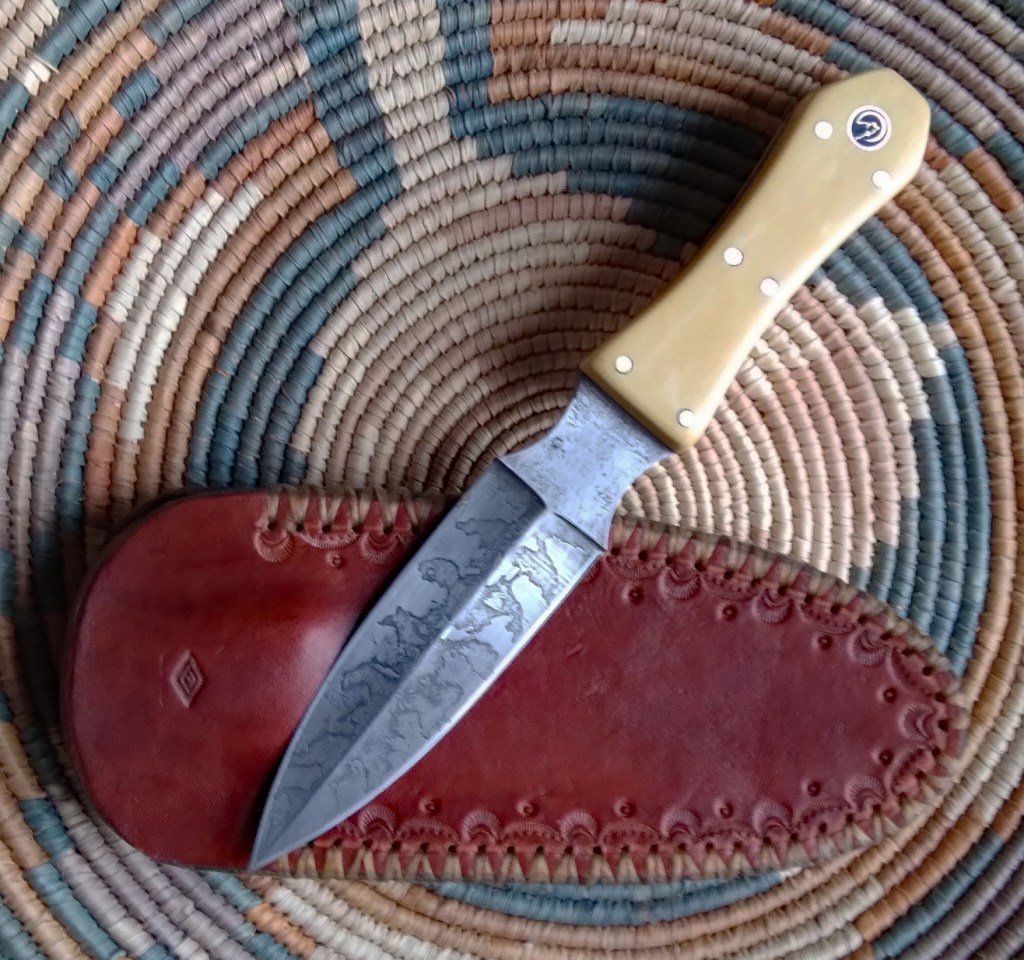
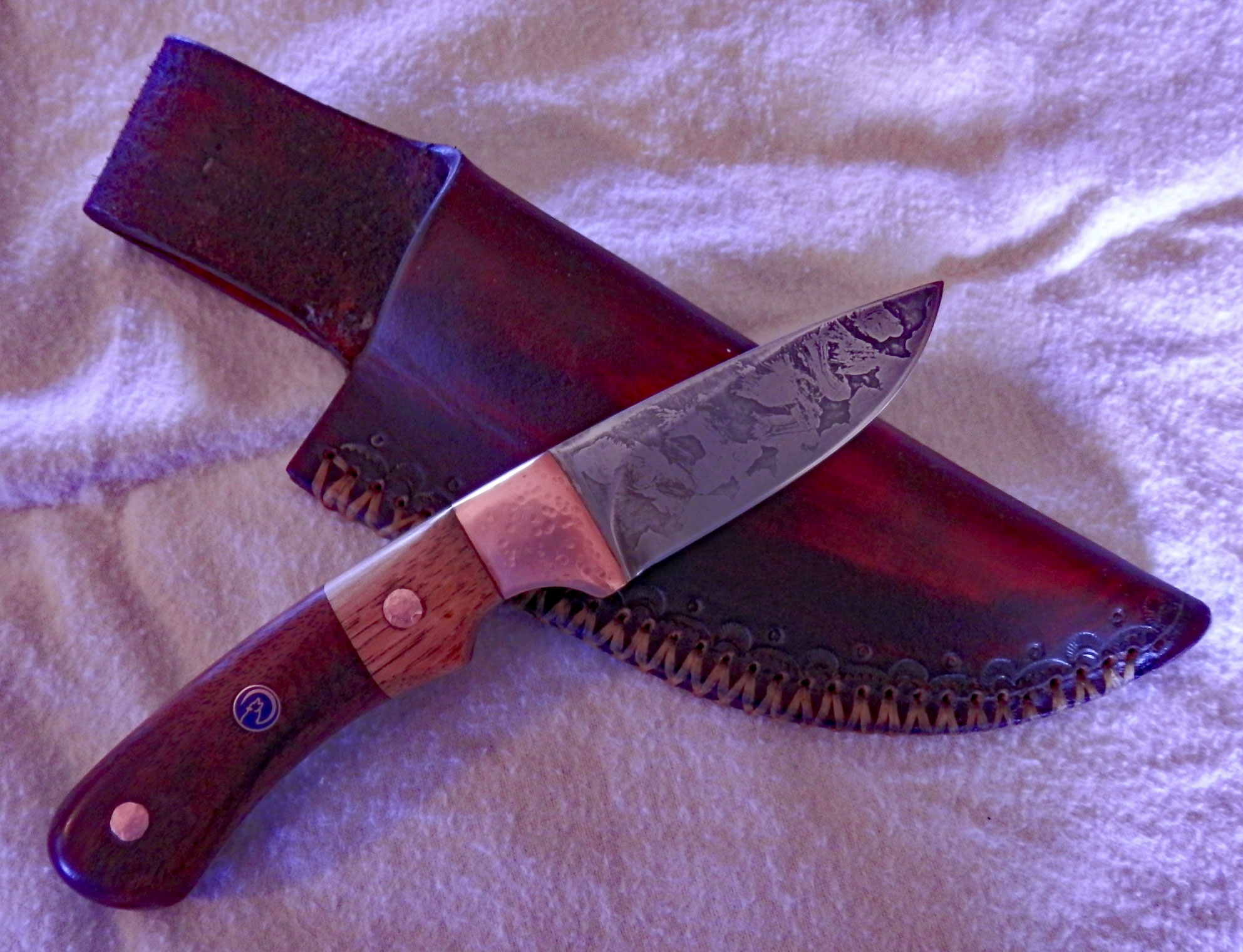
Say “Hello!” to the Nomad, the newest addition to the MoonDog Knives line up.
This is a knife to go everywhere with you, whether you’re hunting, hiking, working on the ranch or farm, working around the house… a knife for all seasons. Small enough to be easily carried and handled by people with smaller hands but big enough to do the job comfortably for someone with bigger hands.
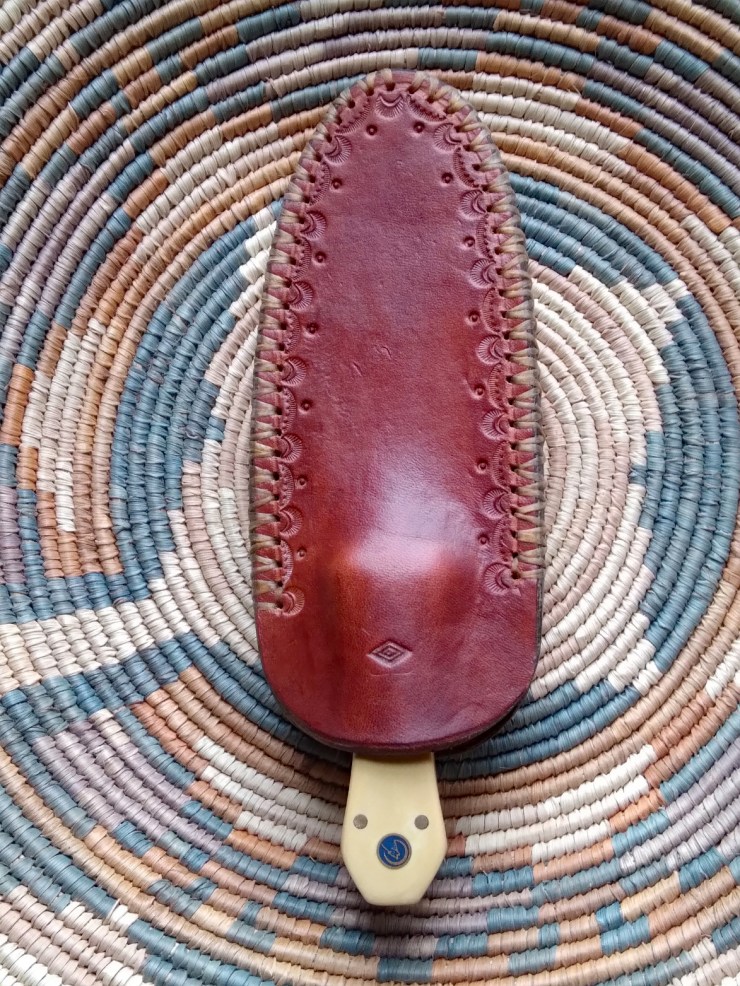
The version pictured here has an oak and walnut handle. The blade is flat ground D2 Tool Steel. The bolsters and pins are copper. The overall length of the knife is 71/2″. The blade is 3″ long, 1″ wide and 5/32″ thick. The sheath is handmade specificly for this knife.
This knife/sheath combo normally will retail for $125 but is now on an introductory offer of $95 until the end of November, so get your Holiday Season shopping done early!
Handles can be in a variety of woods so contact me at moondogknives at gmail dot com.
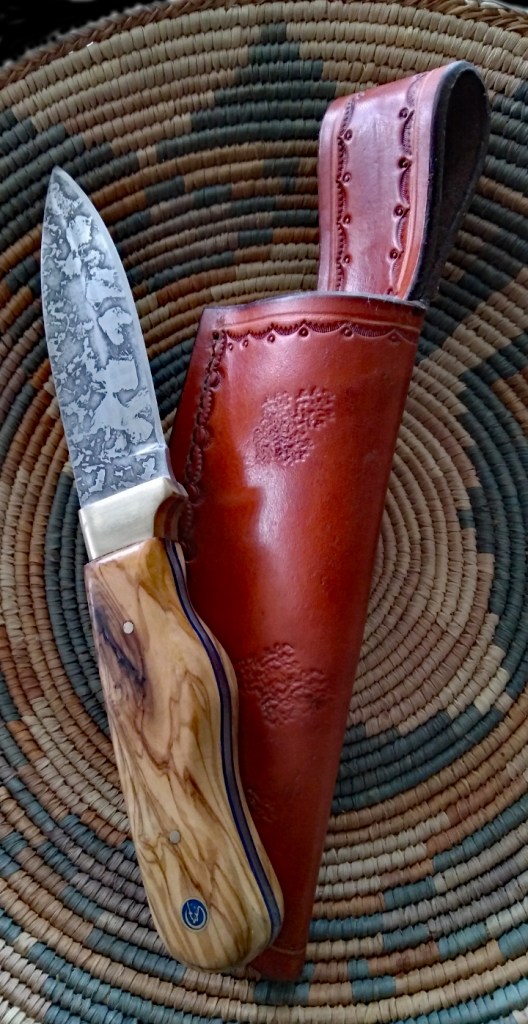
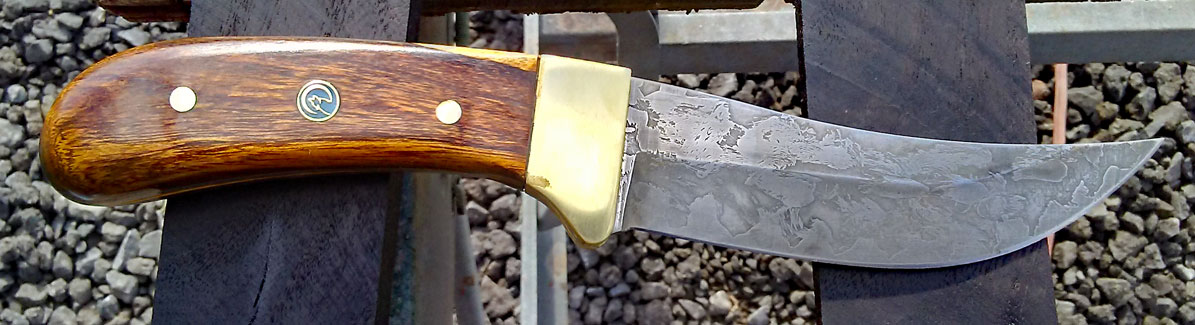
This knife was inspired by a suggestion from a friend who is an experienced, avid hunter. The design is based upon the Cattaraugus from the 1880s. My friend gave many suggestions throughout the development process and I am confident this will be a welcomed addition to any hunter’s collection of working knives. The knife pictured here is the first Kenai Moose Skinner and is already sold. It is a custom build for a client in Alaska. The overall length of the knife is 9″ and the blade alone is 4 3/16″. The blade width is 1 3/16″ and 5/32″ thick.
This knife is made using ‘D-2 Carbon Steel’. I use this steel in the more expensive knives that I make because D-2 is considered by many to be the best carbon steel for knife blades. The combination of superior abrasion resistance and toughness is the result of it’s high carbon and high chromium content.
Unlike the high carbon steel I use in my more economical knives, it is not easy to sharpen so you want to make sure it’s sharp before you head out hunting. On the up side, it holds an edge really well and if properly sharpened should last through the entire animal skinning. Remember that a sharp edge is easier to maintain than it is to put an edge back on a dull knife. Sharpen often.
It is NOT ‘Stainless Steel’ even though it contains chromium, so it needs care and attention to prevent corrosion. This is nothing major, it just means that you clean and dry off the knife after use and put a thin film of rust blocker such as A.G. Russel’s ‘Rust Free’ or some other oil (which I do to every knife before it goes out) regularly. And as with any knife, do not store it in it’s sheath for long periods of time as the chemicals used in tanning process will cause corrosion.
No two knives will be exactly the same because I ‘Electro-Etch’ the blade, which makes every knife unique and the purchaser can choose the wood used in the handle.
For the handle of this knife I used ‘Desert Iron Wood’. For finishing the wood handles of my knives I now use ‘Birchwood/Casey’ gun stock finishing. So maintaining the knifes handle is easy. I also treat each knife handle with Sealer & Filler, Tru-Oil, and Gun Stock Wax to give them a rich, long lasting finish.
You can order your own custom Kenai Moose Skinner for $225 by emailing me at moondogknives at gmail dot com. I accept PayPal, Zelle, Google Pay, and Popmoney and require a 50% deposit on all orders. Approximate wait time on order fulfillment is one month as each knife is individually built.

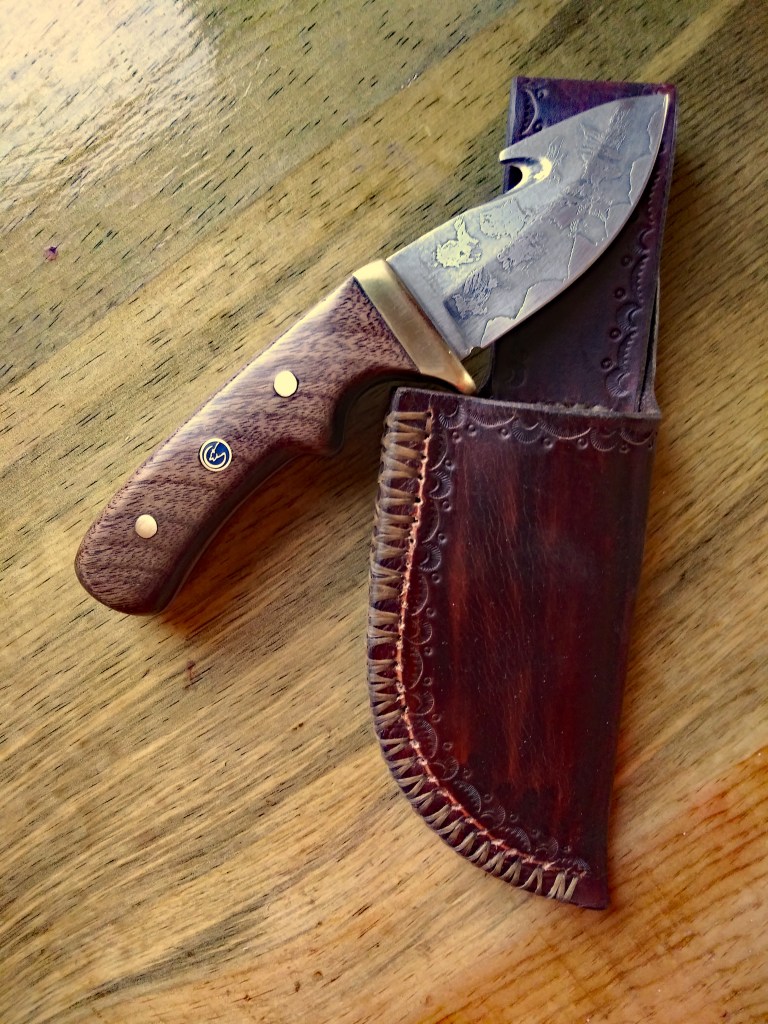



 Say “Hello!” to the Nomad, the newest addition to the MoonDog Knives line up.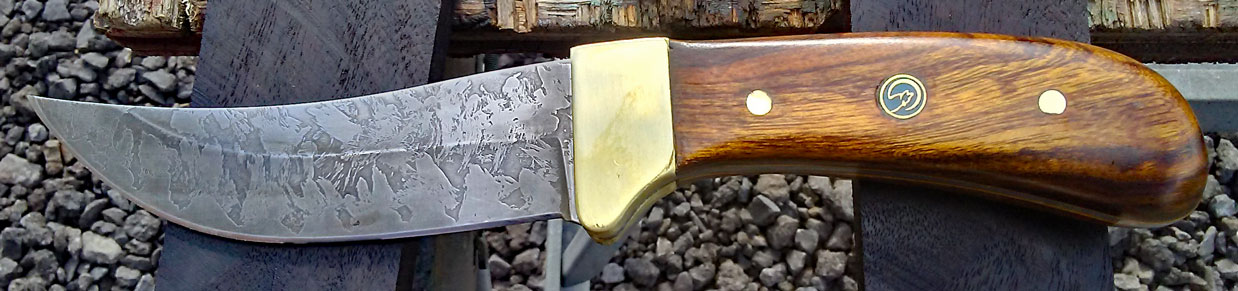
 MoonDog Knives